
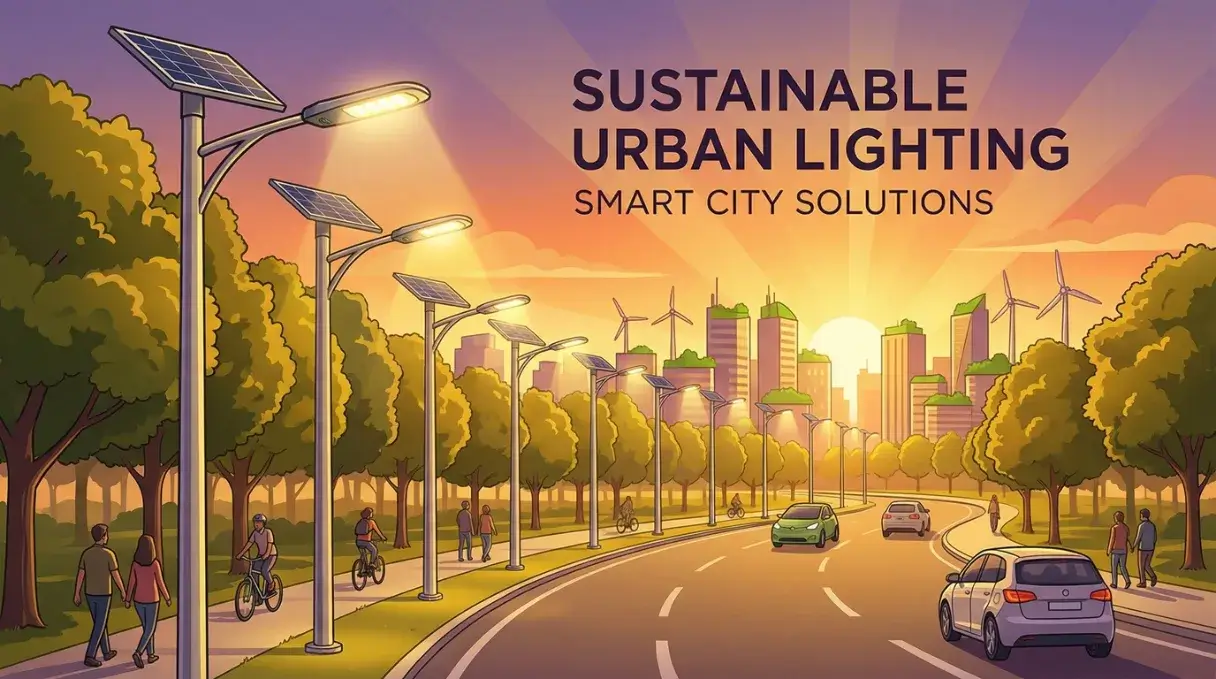
As a representative of green lighting, solar street lights are being widely applied in various scenarios including municipal roads, commercial parks, and residential areas. However, a successful solar street light project requires careful design planning. This article will deeply explore key considerations for solar street lighting design to help you build efficient and reliable lighting systems.
Project Requirements Analysis
Before starting the design, the following key requirements need to be defined:
Basic Information Collection
Including installation location (latitude/longitude), road type (daily traffic), lighting requirements (brightness levels), installation spacing, and maintenance convenience requirements. These factors will directly affect component selection and system configuration.
Solar Resource Assessment
Solar resources at the project site are the core basis for design. By analyzing local historical weather data:
- Average annual sunshine hours and peak sunshine hours
- Longest duration of continuous cloudy weather
- Sunshine variation patterns across different seasons
- Evaluation of potential shading obstacles
System Component Selection
Solar Panels
Solar panels are the energy source of the system. Key considerations for selection:
- Power Selection: Calculated based on lamp power consumption and local solar conditions, generally 40W-200W monocrystalline silicon panels for street light systems
- Conversion Efficiency: Prioritize high-quality panels with efficiency above 22%
- Installation Angle: Optimal tilt angle typically equals local latitude to ensure maximum solar reception throughout the year
MPPT Controller
The MPPT controller is the brain of solar street lights, directly affecting overall system efficiency. When selecting, pay attention to:
⚡ Conversion Efficiency
Prioritize MPPT controllers with 99.9% conversion efficiency. High efficiency means more solar energy is converted to usable electricity, especially significant in low-light conditions.
🔋 Charging Algorithm
Intelligent multi-stage charging algorithms can effectively extend battery life. Quality MPPT controllers feature equalization charging, float charging, and other functions to prevent overcharging and over-discharging.
🌡️ Temperature Compensation
Controllers with temperature sensors can automatically adjust charging parameters based on ambient temperature, ensuring optimal charging in various temperature conditions.
Energy Storage Battery
Lithium batteries are the preferred choice for solar street lights due to their high energy density and long life. Considerations when selecting batteries:
- Capacity Design: Ensure support for at least 3-5 consecutive cloudy days of nighttime lighting
- Depth of Discharge: Choose lithium iron phosphate batteries supporting over 80% depth of discharge
- Cycle Life: High-quality lithium batteries can achieve over 2000 cycles
LED Fixtures
Modern solar street lights commonly use LED light sources. Selection criteria include:
- Luminous efficacy (lumens/watt): Select high-efficacy LEDs above 120lm/W
- Color temperature: 4000K-5000K warm white recommended for road lighting
- Light distribution design: Ensure uniform light distribution and reduce light pollution
- Protection rating: IP65 or above for outdoor environments
System Capacity Calculation
Solar street light system capacity calculation follows these basic principles:
"Daily solar panel power generation = Panel power × Daily peak sunshine hours × System efficiency coefficient Battery capacity = Average daily power consumption × Backup days ÷ Depth of discharge ÷ System voltage"
Example Calculation
Assuming a street light project configuration:
- LED power: 50W
- Daily lighting duration: 10 hours
- Average daily power consumption: 500Wh
- Local peak sunshine: 4 hours
- Consecutive cloudy days: 3
Then needed: approximately 150W solar panel, approximately 2000Wh lithium battery capacity (approximately 160Ah for 12V system)
Installation Tips
Solar Panel Installation
- Ensure installation location is unobstructed with direct sunlight for at least 6 hours
- Adjust tilt angle to optimal angle, with seasonal fine-tuning considered
- Fixed brackets must be sturdy and able to withstand local maximum wind speeds
Controller Installation
- Install inside light pole or dedicated control box
- Ensure good heat dissipation conditions, avoid direct sunlight
- Wiring sequence: Connect battery first, then load, finally solar panel
Maintenance Recommendations
To ensure long-term stable operation of solar street light systems, the following maintenance plan is recommended:
- Quarterly Inspection: Clean solar panel surface, check bracket stability
- Annual Inspection: Test battery capacity, internal resistance and other key parameters
- Real-time Monitoring: Choose MPPT controllers with communication functions for remote monitoring
Conclusion
Solar street lighting design is a systematic project requiring comprehensive consideration of solar resources, load requirements, component performance, and local environment. By selecting high-efficiency MPPT controllers and quality system components, you can build environmentally friendly and economical lighting solutions. As a professional MPPT controller manufacturer, SUNOPEN is committed to providing reliable core control units for solar street light projects, supporting the development of green lighting.

