
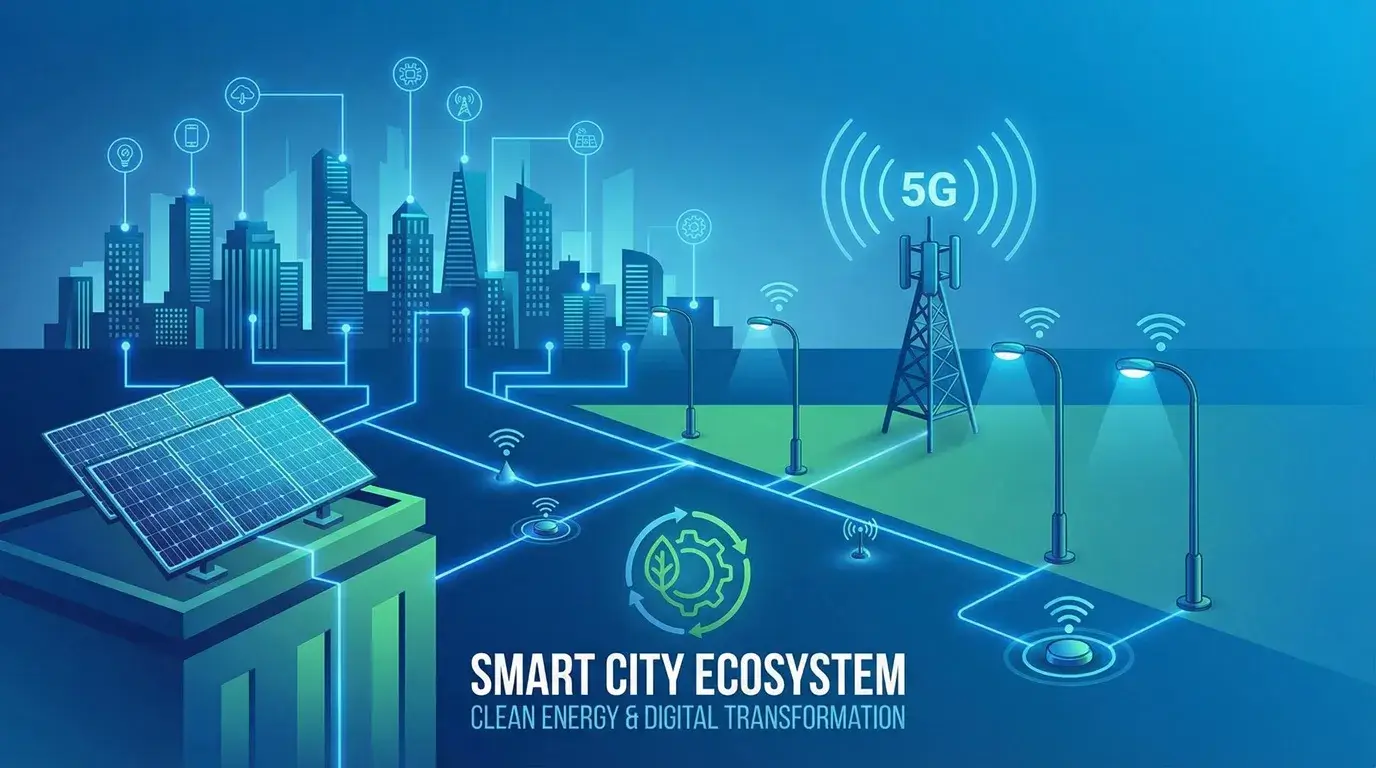
As global urbanization accelerates, smart city construction has become a major development strategy for nations worldwide. In this digital transformation, IoT technology plays a central role, while solar power systems provide clean and sustainable energy solutions for these intelligent devices.
Solar IoT: The New Foundation of Smart Cities
Traditional urban IoT devices rely on grid power, which not only increases infrastructure costs but also limits device deployment in remote areas. Solar IoT solutions combine MPPT controllers with energy storage systems to enable grid-free deployment of devices, significantly expanding smart city coverage.
Key Advantages
Solar IoT systems can reduce wiring costs by over 90% while achieving zero carbon emissions, aligning with smart city sustainable development principles.
Main Application Scenarios
Smart Streetlight Systems
Smart streetlights are among the most common IoT applications in smart cities. By integrating solar panels, MPPT controllers, LED lights, and sensors, city managers can achieve:
- Automatic brightness adjustment based on ambient light and traffic conditions
- Real-time monitoring of streetlight status for predictive maintenance
- Integrated environmental monitoring sensors (PM2.5, noise levels, etc.)
- Flexible deployment of 5G micro base stations and WiFi hotspots
Environmental Monitoring Networks
Distributed environmental monitoring stations are crucial for urban air quality management. These stations need to operate around the clock, collecting data including air quality, noise levels, and water quality. Solar power systems ensure reliable operation in various weather conditions, unaffected by grid failures.
Smart Parking Sensors
Magnetic parking sensors need to be embedded underground, making traditional wiring methods costly. Solar-powered smart parking systems are not only easy to install but can also achieve long-term stable operation through the combination of solar panels and built-in batteries, providing real-time parking space status feedback.
Technical Architecture and Core Components
A complete solar IoT power supply system typically includes the following core components:
☀️ Solar Panels
Select solar panels with appropriate power based on device power consumption and local solar conditions. Monocrystalline silicon panels perform better in low-light conditions, ideal for urban environments.
⚡ MPPT Controller
The MPPT controller is the core of the system, responsible for maximizing solar panel energy harvesting. SUNOPEN's MPPT controllers can achieve 99.9% conversion efficiency, ensuring optimal performance under various lighting conditions. Advanced MPPT algorithms can quickly track the maximum power point, maintaining high efficiency even in cloudy or shaded conditions.
🔋 Energy Storage System
Lithium battery storage systems store excess energy generated during the day for use at night or on cloudy days. Intelligent BMS systems ensure battery safety and longevity.
📡 Communication Module
Through Bluetooth, WiFi, or 4G/5G modules, IoT devices can transmit collected data to cloud management platforms for remote monitoring and control.
System Design Considerations
When designing solar IoT power supply systems, the following factors need to be comprehensively considered:
- Power Consumption Analysis: Accurately calculate average and peak power consumption
- Solar Conditions: Reference historical weather data to ensure backup days during rainy weather
- Installation Location: Evaluate solar panel installation angle and shading conditions
- Maintenance Schedule: Design reasonable maintenance plans, including battery replacement cycles
"Solar IoT is not just a technological innovation, but a strategic choice for urban sustainable development. By deploying solar-powered IoT devices, we can build truly green and intelligent modern urban infrastructure."
Future Development Trends
With continuous advancement of photovoltaic technology and sustained cost reduction, the application prospects for solar IoT will become even broader. Several directions are worth attention:
- Higher Efficiency: New perovskite solar cells and bifacial power generation technology will further improve power generation efficiency
- Smart Scheduling: AI-driven energy management systems will optimize solar energy distribution and usage
- Standardization: Unified IoT solar power supply standards will simplify device deployment and integration
- Edge Computing: Localized data processing will reduce communication energy consumption and extend battery life
Conclusion
Solar IoT infrastructure is reshaping the energy landscape of smart cities. By adopting high-efficiency MPPT controllers and advanced energy storage technology, cities can build more environmentally friendly, efficient, and intelligent infrastructure networks. As a professional MPPT controller manufacturer, SUNOPEN is committed to providing reliable solar power solutions for smart city projects, jointly promoting green and sustainable urban development.

