
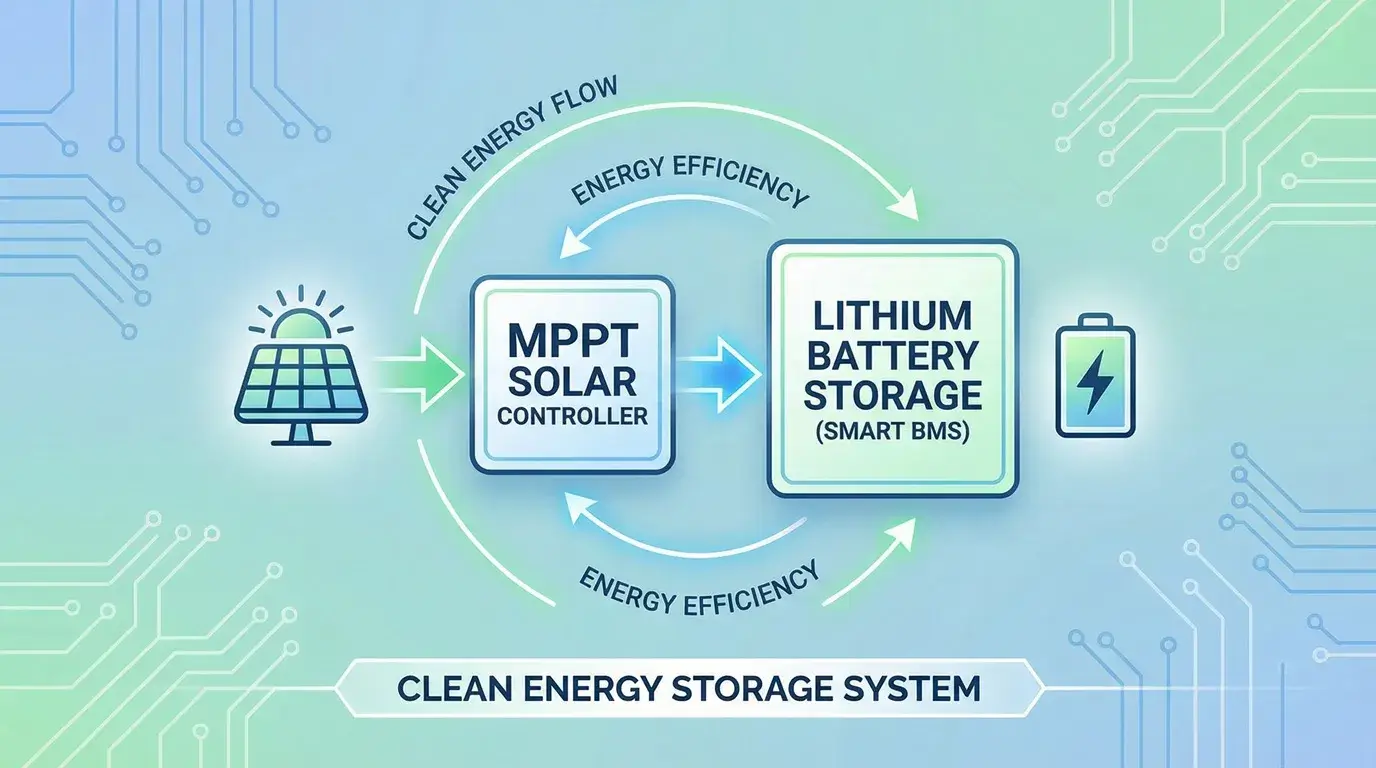
Batteries are the most critical energy storage component in solar systems, and proper charging management directly determines battery performance and lifespan. As the core of solar systems, MPPT controllers protect batteries and maximize their service life through advanced charging algorithms. This article provides a detailed introduction to MPPT controller charging mechanisms and best practices.
Understanding Multi-Stage Charging
Modern MPPT controllers use intelligent multi-stage charging algorithms, which is key to battery protection and longevity. Typical charging stages include:
⚡ Bulk Stage
When battery voltage is below the preset threshold, the controller charges the battery at maximum current. This stage typically charges the battery to about 80% capacity. Efficient MPPT controllers maximize solar energy utilization during this stage, converting as much energy as possible into stored battery power.
🔋 Absorption Stage
When battery voltage reaches the absorption threshold, the controller switches to constant voltage charging mode. As the battery gradually fills, charging current naturally decreases. This stage is crucial for ensuring the battery is 100% full, preventing capacity memory effect.
🌊 Float Stage
After the battery is fully charged, the controller switches to float mode, maintaining a lower constant voltage to compensate for battery self-discharge. This keeps the battery at full charge without overcharging, ideal for long-term storage.
🔄 Equalize Stage
For lead-acid batteries, periodic equalization can balance the state of individual cells in the battery pack, preventing sulfation. For lithium batteries, some high-end MPPT controllers also provide equalization functions to optimize battery pack consistency.
Battery Types and Charging Settings
Lithium Batteries (Li-ion/LiFePO4)
Lithium batteries have become the mainstream choice for solar systems due to their high energy density and long cycle life. Key charging management points:
- Charging Termination Voltage: LiFePO4 batteries typically 3.65V/cell, NMC batteries 4.2V/cell
- Overcharge Protection: Strictly prohibit exceeding rated voltage; high-end MPPT controllers have precise voltage detection
- Temperature Compensation: Charging parameters need adjustment based on temperature to prevent lithium plating at low temperatures or overcharging at high temperatures
Lead-Acid Batteries
Although energy density is lower, lead-acid batteries remain widely used in large-scale storage systems due to lower cost and mature technology:
- Sealed Lead-Acid/AGM: Charging voltage 14.4-14.8V (12V system), float voltage 13.5-13.8V
- Gel Batteries: Charging voltage slightly higher than AGM, similar float voltage
- Regular Equalization: Perform equalization charging monthly to maintain battery pack consistency
Important Notice
Regardless of battery type, ensure MPPT controller charging parameters match battery specifications. Incorrect settings may cause battery capacity degradation or even safety incidents. Carefully read battery and controller manuals before settings.
Temperature Compensation Mechanism
Temperature is a key factor affecting battery charging efficiency and safety. High-quality MPPT controllers feature built-in temperature compensation:
- Equipped with external temperature sensor for real-time battery temperature monitoring
- Automatic charging voltage adjustment based on temperature: increase voltage at low temperature, decrease at high temperature
- Typical compensation coefficient is -3mV/°C/cell to -5mV/°C/cell
- Automatic charging current limiting at extreme temperatures to protect battery
"Temperature compensation is the most overlooked yet crucial function in battery charging management. Ignoring temperature factors can cause battery capacity to degrade 5-15% annually."
Practices for Maximizing MPPT Efficiency
In addition to proper charging settings, the following practices can help maximize solar system efficiency and battery life:
Solar Panel Configuration Optimization
- Ensure panel voltage is at least 5V higher than battery voltage to ensure normal MPPT operation
- Consider temperature effects on panel output and leave sufficient voltage margin
- For high-power systems, use multiple series-parallel configuration to optimize system efficiency
Regular Maintenance Inspection
- Monthly check battery terminal connections, ensuring no corrosion or looseness
- Regularly measure voltage consistency of individual battery cells
- Check controller display data, monitor charging status and cumulative power generation
Avoid Deep Discharge
Deep discharge is the main killer of battery life. Recommendations:
- Keep lithium battery depth of discharge within 80%
- Keep lead-acid battery depth of discharge below 50%
- Use MPPT controller's Low Voltage Disconnect (LVD) function to protect battery
Frequently Asked Questions
Q: Why does my battery always fail to fully charge?
A: Possible reasons include: insufficient solar panel power (cloudy or shading), improper charging parameter settings (absorption time too short), increased battery internal resistance due to aging. Check solar panel cleanliness, reset charging parameters, and consider battery health status.
Q: Controller shows "Full" but battery is not truly charged?
A: This is a typical charging termination condition setting problem. It may be because absorption time is set too short or float voltage is set too high. Adjust parameters according to battery type.
Q: What to do when charging efficiency significantly decreases in winter?
A: Reduced solar radiation in winter is normal. Consider: increasing solar panel power, enabling temperature compensation to ensure correct charging, reducing load usage to lower discharge.
Conclusion
Proper battery charging management is the foundation for long-term stable operation of solar systems. By selecting MPPT controllers with advanced charging algorithms (such as SUNOPEN 99.9% efficient MPPT controllers), correctly setting charging parameters, and performing regular maintenance, you can significantly extend battery life and achieve the best return on investment. Remember, batteries are one of the most expensive components in the system, and careful maintenance will bring long-term benefits.

